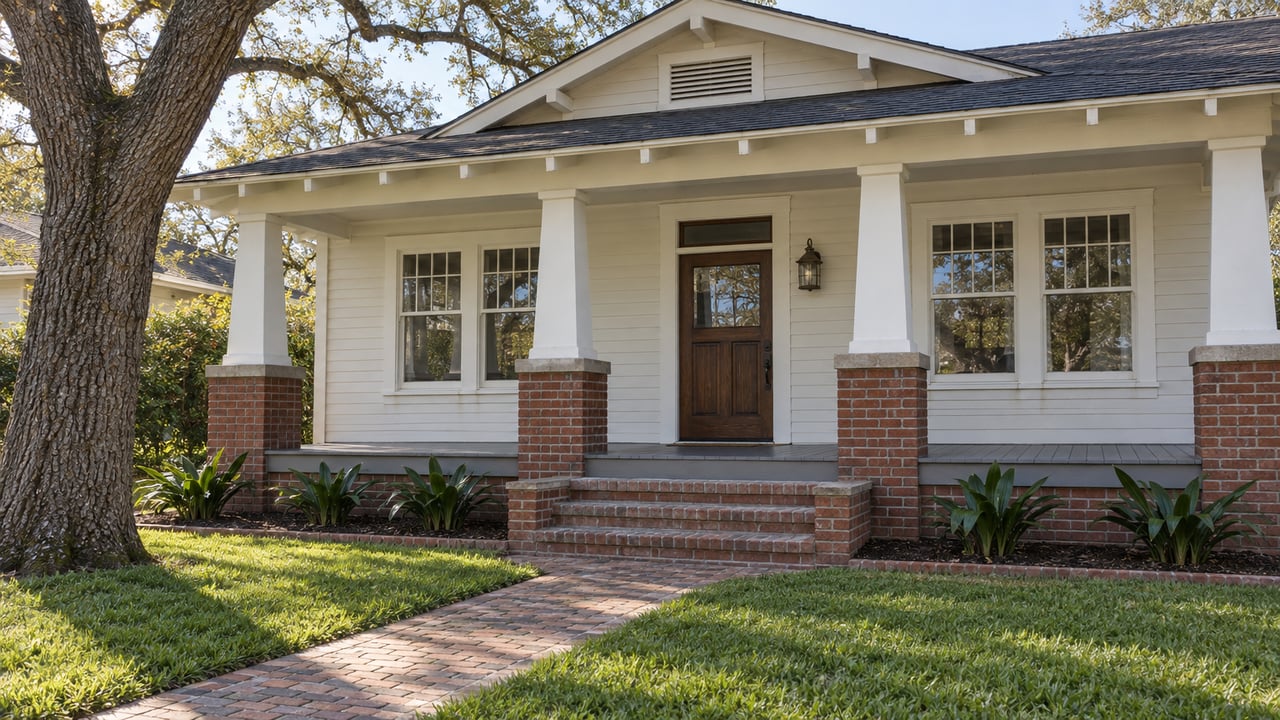
At Audubon, on the FM 1488 side of Magnolia, Smith Douglas Homes is advertising select homes in its Audubon 40's section with rates starting at 4.99% on a 5/1 ARM, 6.636% APR. The offer comes with special pricing and closing-cost assistance. One move-in-ready home on Slough Way is listed at $329,990, cut from $347,370. Elsewhere in Audubon, Perry Homes' year-end sales event lists a move-in-ready Audubon Park 60' home on Dangling Crest Court with rates as low as 4.99%, 5.898% APR. At Mill Creek, D.R. Horton advertises a 5.5% special rate on select homes.
These offers were all advertised in mid-November, and they share one feature. The builder is discounting the loan more than the house. In Magnolia this season, that makes the listing price a weak tool for comparing a resale home with a new one. The comparison that holds up is the monthly payment, and on that measure the gap between a builder's rate and the market rate is worth more than most resale price cuts.
The rate the rest of the market is paying
Freddie Mac's weekly survey put the 30-year fixed average at 7.11% as of November 12, 2026, its fourth straight weekly decline. A year earlier, the same survey stood at 6.24%. A buyer financing a resale home in Magnolia with no seller help is borrowing at roughly that market rate. A buyer at Audubon or Mill Creek may be borrowing two points lower, depending on the home and the loan.
That spread is large. Freddie Mac stopped publishing an average for adjustable-rate loans in November 2022, so there is no official ARM benchmark to set beside the Smith Douglas figure. The fairest way to read a 4.99% 5/1 ARM is as a low payment that is fixed for the first five years. After that, it adjusts.
What 4.99% is worth in dollars
Builders pay for a lower rate the same way any borrower would, by buying down the loan. Bankrate's guide to mortgage points, updated September 30, 2026, says one point costs 1% of the loan balance and often lowers the rate by about 0.25 percentage point. That puts a full point off the rate at roughly 4% of the loan, though lender pricing varies. Temporary buydowns cost less and work differently. A 3-2-1 buydown lowers the payment by 3, 2 and then 1 percentage point in the first three years, and then the loan returns to its note rate. In Rocket Mortgage's example of a $300,000 loan at a 7% note rate, a 2-1 buydown is worth about $6,992 and a 3-2-1 about $13,756.
To bring this down to a Magnolia kitchen table, take a $500,000 loan amortized over 30 years. The figures below are my own principal-and-interest arithmetic. Taxes, insurance and any association dues are not included.
| Rate on a $500,000 loan | Approximate monthly principal and interest | Monthly gap vs. 7.11% | Loan reduction needed at 7.11% to match the payment |
|---|---|---|---|
| 7.11%, Freddie Mac 30-year average, Nov. 12, 2026 | $3,364 | baseline | baseline |
| 5.50%, the rate D.R. Horton advertises at Mill Creek | $2,839 | about $525 | about $78,000 |
| 4.99%, the starting rate Smith Douglas and Perry advertise at Audubon | $2,681 | about $683 | about $100,000 |
The last column is the number to remember. For a buyer borrowing at the market rate to get the same monthly payment as a 4.99% builder loan, the loan would need to be about $100,000 smaller. Over the five fixed years of a 5/1 ARM, a $683 monthly gap adds up to about $41,000. That lines up closely with the Bankrate rule of thumb, which prices a 2.12-point permanent rate cut on a $500,000 loan at a little over $42,000 in points. The two methods give about the same answer from different directions, so the builder's offer is worth something in the low-to-mid $40,000s to the builder and feels like a six-figure discount to a buyer watching the monthly payment.
This is general information, not financial advice. Rates, APRs and buydown pricing depend on the borrower and the lender, so confirm any figure with your own loan officer before you act on it.
October's sales count shows the pressure
Houston Association of Realtors data for ZIP 77354 shows 107 sales in October 2026, down from 150 in October 2025. Median days on market rose from 41.5 to 52 over the same months. The median sold price in 77354 actually rose over that year, from $326,995 to $355,947, and the October 2026 average was $464,231. When fewer homes sell and the median goes up, the mix of homes selling has usually changed. A drop of about 29% in transactions, during a year when the 30-year rate climbed close to a full point, says more about the market than the median does.
In ZIP 77355, October 2026 had 49 sales at a median of $299,800, against $326,645 in October 2025, with median days on market at 54. The two ZIP codes moved in opposite directions on price, and both took longer to sell.
Two halves of the 1488 corridor, two speeds
HAR splits the area into Magnolia/1488 East and Magnolia/1488 West, and for November 2026 the two halves look different. East has 5.8 months of inventory, listings up 21.7% from a year earlier, an average of 56.1 days on market and a $495,205 median sold price. West has 6.5 months of inventory, listings down 2.4%, an average of 69.5 days on market and a $457,824 median sold price. November's active counts are 404 in East and 977 in West.
HAR reports these market areas separately from the ZIP codes, so their medians and the ZIP medians measure different sets of sales. The inventory figures still matter for the rate story. At six months of supply, a buyer has time to tour a resale home on Saturday and a builder's model on Sunday, and then compare the two payment quotes before writing an offer on either one. In West, with nearly 1,000 active listings, homes take longer to sell than in East. That gives a resale seller there more reason to price against the builder's monthly payment and not just against the house down the street.
The builders have more lots coming
The builders' rate offers are tied to how much they still have to sell. Magnolia's building moratorium expired on December 14, 2025, as Community Impact reported. At the time, the outlet reported that the city was nearing completion of $30.2 million in water infrastructure additions and maintenance. Our earlier look at Magnolia's three-year water freeze covered how that pause held back new-construction supply.
Two large pipelines are planned. My Neighborhood News reported in January that Audubon had started civil work on its Heron Run phase, planned for 1,400 homesites, with Perry Homes, Drees Custom Homes and Westin Homes expected to build there. In March, the same outlet reported that Grand Magnolia is planned across 2,755 acres for more than 6,900 families, with nearly 1,000 homes in its first phase and six named builders. A builder bringing out new sections has every reason to keep moving finished homes. Discounting the rate does that without lowering the price on the closing record, which the next buyer in the neighborhood will see as a comparable sale.
Reading a resale listing against a builder offer
For a buyer comparing Magnolia with nearby suburbs, the useful habit is to turn every option into a monthly payment before comparing prices. A resale home in an established Magnolia neighborhood may have a lower price per foot, mature trees or acreage that a 40-foot or 60-foot builder lot can't provide. Our guide to Magnolia's acreage communities covers that side of the market. Whether those features are worth a $500 to $700 monthly difference is the question to answer, and a list price alone won't answer it. Also find out whether the builder's rate depends on using the builder's lender, whether it applies to the home you want or only to "select homes," and what the loan does after the five-year mark on an ARM.
For a resale seller, the builder down the road sets the payment buyers compare against, even when the asking prices look similar. A price cut gets reflected in the comps. Money put toward the buyer's rate, if the buyer's lender allows it, competes on the measure the builders have chosen. In a 77354 market where October sales took a median of 52 days, sellers who know how much a builder's buydown is worth can decide how to spend a concession budget instead of reacting to days on market. A home valuation is the starting point for either approach.
A few questions buyers ask directly
Is a 4.99% builder rate the same as a 4.99% 30-year fixed? Not in the Smith Douglas case. That offer is advertised as a 5/1 ARM with a 6.636% APR, and the Perry Homes offer shows a 5.898% APR beside its 4.99% rate. The APR includes costs that the headline rate leaves out.
Are these offers still available? They were on the builders' sites in mid-November 2026 and show no end dates. Perry calls its promotion a year-end sales event, and offers like these can change week to week.
Why does Magnolia's median price look stable if sales are slowing? In 77354, October's median went up while the number of sales fell from 150 to 107 compared with a year earlier, which points to a change in the mix of homes selling.
If you're weighing a Magnolia resale against a builder's rate offer, or pricing your own home against one, Melissa King can put both options into side-by-side monthly numbers before you make a move. Book a complimentary home strategy call and we'll work through the comparison with your lender's quotes.